

Buying an existing home in water's edge?
- 1) Before closing, please contact the Water’s Edge Owners Association at watersedgeoa@gmail.com to obtain a Status Certificate confirming that all dues are current and the property complies with community covenants.
- 2) Review the Covenants and the Owner’s Association information below.
Owner & Resident Resources
Welcome Package
The Water’s Edge Welcome Package is designed to protect your investment and enhance our shared community culture. It provides essential guidance on environmental protections, design reviews, and owner responsibilities. Click the link below to access the full document.
Annual Maintenance Fees & Finance
Annual Association Dues
Each year, all homeowners are required to submit their annual homeowners’ association dues by January 1st.
The dues for 2027 will be $274.00 and will be due by January 1st, 2027.
Interest does accrue on dues submitted late and legal fees incurred by the WEOA associated with collecting outstanding dues are the responsibility of the homeowner.
Annual General Meeting (AGM)
Each winter there is an annual general meeting for all homeowners to attend. At this meeting the current board of directors will recap the accomplishments from the previous year, present the previous year’s budget vs spending, and propose a new budget for the year going forward.
There is also biyearly voting for board of directors positions. Current positions include:
- • President
- • Secretary
- • Treasurer
- • Communications Director
- • Land Management Director
- • Lake Management Director
- • Social Committee Director
Community Amenities & Managed Properties
WEOA Maintained Properties
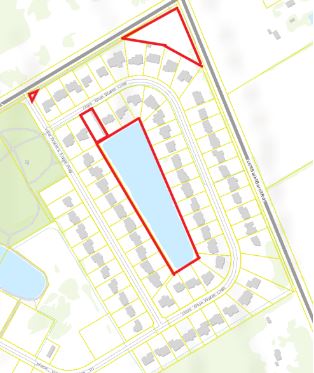
The Water’s Edge Owners Association (WEOA) is responsible for the ongoing maintenance and stewardship of four distinct common properties within our community:
- 📍 Entrance Parcel: A small parcel of land at the community entrance (North East side of Water’s Edge), which houses our community signage.
- 🌳 The "Back Lot": An approximately 0.67-hectare lot featuring grass and trees, located at the corner of Parkway and Sale Barn.
- 🏐 The "Beach Lot" (7309 Blue Water): A 0.2-hectare lot that provides community access to the beach, dock, and volleyball court.
- 🌊 The Lake & Shoreline: 2.2 hectares encompassing the lake itself, the shoreline, and a perimeter buffer of land surrounding the water.
Property Boundary Map
Please see the image below with the Association lots outlined in red.
Bylaw Compliance
This policy outlines our commitment to a “spirit of communication” in maintaining community standards and protecting your property investment. It explains the measured steps the Board takes to resolve misunderstandings regarding deed restrictions, ensuring a harmonious environment for all residents.
Deed Restrictions & Covenants
This document outlines the legally binding protective covenants and building restrictions that run with the land at Water’s Edge to ensure a consistent, high-quality community standard. It covers essential architectural requirements, environmental protections, and property maintenance obligations designed to preserve the collective aesthetic and long-term value of all homes within the development
Design Review Process
Building a home in a Sunset Lakes Community is an exciting and rewarding journey, representing a significant investment in your future. The quality of your residence—and those of your neighbors—is paramount, not only to protect that financial investment but to maximize your long-term enjoyment of the community.
The Design Review Process is established to ensure enduring community standards. Designs accepted through this process typically offer greater architectural interest and character than is commonly found in standard tract-designed or production housing.
Every home in South Village must undergo this review by the developer or its appointee and receive formal acceptance before construction begins. The intent is not to impose arbitrary aesthetic judgments or to unduly restrict owners. Instead, the process aims to promote individual creativity, encourage thorough planning, and coordinate a diverse blend of architectural styles that enhance the entire neighborhood. This process supplements the legal requirements found in the Covenants and Restrictions for each specific community.
The Four-Step Procedure
Step 1: Review existing homes in the area to gain inspiration from previously accepted designs.
Step 2: Submit a preliminary concept sketch and discuss your ideas with a member of the Design Review Committee to ensure your project is headed in the right direction.
Step 3: Submit a formal Design Review Application. This must include building plans, elevations for all four sides, and a detailed site plan depicting the house, driveway, lamps, setbacks, tile beds, and total square footage. At this stage, refinements may be suggested.
Step 4: Receive your official written Design Review Approval.
Pre-Construction Considerations
Roadside Ditches: Ditch grades are set according to approved engineering designs and have been strictly inspected. These ditches require a specific surface slope to manage rainwater and runoff. Furthermore, driveway culverts must be installed according to the drainage design. These grades must remain untouched to ensure proper drainage and sub-drain function; do not add sod, fill, or topsoil, and ensure no vehicles drive over these areas.
Zoning & Compliance: This approval does not warrant compliance with municipal zoning by-laws, building codes, or other legal requirements. The responsibility for meeting all municipal standards and City-approved footing levels remains solely with the owner.
Grading & Drainage: A specific grading and drainage plan is registered on the title of each lot. Every owner is required to comply with this plan prior to receiving final approval for their home.
Lamp Posts: To maintain community character, all lots must feature two (2) photocell-operated lawn lamps on pedestals. These must be placed on both sides of the driveway and set back 1.5 meters from the road allowance.
Future Improvements: Please note that all future improvements—including sheds, pools, fences, hedges, and retaining walls—require separate design review approval to maintain community standards.
Design Review Application Form
Official Design Review Application
To ensure your project is processed without delay, all homeowners and builders must complete the formal Design Review Application. Please note that we cannot accept project details or sketches pasted directly into an email; the official document must be downloaded, filled out in full, and submitted as a complete package.
Submission Requirements:
Complete the Form: Download & Print the PDF below and ensure all property and owner details are accurate.
Attach Required Documentation:
Elevations and Floor Plans: Detailed architectural drawings of all four sides.
Site Plan: A layout depicting the house, driveway, and setbacks.
Tree Planting and Conservation Plan: A sketch indicating clearing areas and post-construction planting.
Technical Specifications: Any additional building details required for the review.
Formal Acknowledgment: The signed application confirms your commitment to the approved design.
How to Submit: Once completed, email the form and all supporting documents to sunsetlakes@rogers.com or deliver a hardcopy to the Sunset Lakes Developments office at 1280 Fox Valley Rd., Greely. Please allow up to 30 days for the committee to review your application and provide a response.
Property Improvements & Landscaping
This application process is specifically for homeowners who have already completed their initial home construction and are now seeking to add exterior features or secondary structures.
External Property Improvements & Landscaping
To maintain the high standards and aesthetic harmony of our communities, all exterior modifications made after your home is built require formal approval from the Owners Association Design Review Committee before any work begins. Please note: We cannot accept project details or sketches pasted directly into an email. You must download, complete, and submit the official application form below.
Step 1: Review Our Community Standards
Before starting your application, please review our specific requirements for each project type to ensure your plan meets neighborhood guidelines:
- Sheds & Exterior Structures
- Fences, Hedges, and Privacy Screens
- Swimming Pools
- Tree Retention & Planting
Step 2: Prepare Your Required Documentation
Your submission must be sent as a complete package including:
- Completed Application Form: Downloaded, filled out, and signed.
- Detailed Site Plan: Indicating the exact location of the proposed improvement and setbacks.
- Tree Planting & Conservation Plan: A sketch indicating clearing areas and post-construction planting.
- Technical Documentation: Full specifications, plans, or elevations relevant to the project.
Step 3: Submit for Review
Email your completed form and all supporting files to watersedgeoa@gmail.com. Please allow up to 30 days for the committee to review your proposal and provide a response.
Request for action
Request for Action or Information
To submit your request: Please copy the form below into an e-mail, complete all details and e-mail to watersedgeoa@gmail.com. You must also attend the next WEOA Board meeting to address issues directly.
Date: _______________________________
Name of Requester: ________________________________________________________
Address: ________________________________________________________________
Phone Number: __________________________________________________________
Email Address: ___________________________________________________________
1. Particulars of matter:
__________________________________________________________________________
__________________________________________________________________________
__________________________________________________________________________
__________________________________________________________________________
2. Proposed options:
__________________________________________________________________________
__________________________________________________________________________
__________________________________________________________________________
__________________________________________________________________________
3. Recommended solution:
__________________________________________________________________________
__________________________________________________________________________
__________________________________________________________________________
__________________________________________________________________________
4. I am available to assist WEOA as follows:
__________________________________________________________________________
__________________________________________________________________________
__________________________________________________________________________
__________________________________________________________________________
5. (To be completed by WEOA Board) Final action taken:
__________________________________________________________________________
__________________________________________________________________________
Tree planting
Tree planting and conservation will be undertaken on a lot by lot basis using the following guidelines:
- Typical Lot. Tree planting conservation plan on figure 1 attached showing the areas of a typical lot after allowing for house, yard, driveway, septic area and street.
-
Restrictive Covenants registered on title to each lot require:
- the owner to submit for approval a detailed site plan with the application for design review approval. Tree conservation and planting will be addressed as part of the review; and
- No tree in excess of 100 mm in diameter can be removed after construction of the home except for driveway, septic, and living area.
-
Tree conservation and planting guidelines:
-
Maintaining existing trees:
- Retain all existing trees whenever possible. Ensure that trees onsite are protected from grade change, equipment damage and root compaction during construction.
- If the trees have too much fill built up around them they will not survive more than five years after construction.
- If equipment has been driving over the root system then aeration of the soil to relieve compaction should be undertaken.
- If there has been damage to the tree trunk by equipment, the area should be cleaned and torn bark removed.
- Existing trees have successfully established their root systems in the soil on site whereas trees introduced to the site may have been grown in a different type of soil and will undergo planting shock and adjustment to the new soil conditions.
-
Pruning, watering, staking and mulching:
- Pruning of trees should be kept to the minimum. Removing foliage will reduce photosynthesis and the production of food for the tree. The reasons for pruning are to improve structure by removing weak branches, removing dead or diseased branches and removing crossing or rubbing branches. Pruning to develop the structure of the tree should be done on the tree as soon as possible. Pruning a young tree for structure will help it develop better and faster and will create less damage by keeping the pruning cuts small.
- Water is critical for successful tree growth. There are correct and incorrect methods of watering. Frequent, shallow watering encourages surface roots and soil compaction, which will make the tree more susceptible to drying out during periods of drought. The best method of watering is infrequent, deep soakings that will encourage deeper root growth, less compaction and healthier trees that can survive periods of drought. The best time to water is during the morning when evaporation is minimized. It is best to let the hose trickle water onto the root area for a longer period of time instead of using a sprinkler. Remember, you can over-water the tree or underwater the tree, but the result will be the same – loss of your tree. Good water management is critical to the success of your tree.
- Staking a tree is not always necessary. Staking a tree too tightly will cause more damage than not staking a tree at all. Trees that are not staked produce a better root system, a better trunk taper and a structurally stronger tree. If the tree cannot remain upright by itself, then staking will have to take place. When the tree is staked it should have some movement in the wind and should not be tightened to the point of being rigid. Tree staking can be done with one, two or three stakes.
- Mulching the soil around the base of trees is beneficial. The mulch will reduce water evaporation from the soil, reduce soil erosion and improve soil aeration. The soil will remain cooler in the summer and protect the root system from summer heat. Mulch should be kept away from the tree trunk in order to prevent rot and fungus. The mulch layer should be 3 to 4 inches in depth and not any deeper. More mulch is not better and will cause problems with tree health and growth.
-
Managing Common Pests:
- Pest infestations are common throughout all tree plantings. The best way to fight pest infestation is to keep your trees as healthy as possible. All healthy trees have a better chance to withstand levels of infestation without the need to treat with pesticides. If the infestation is heavy enough to defoliate the tree then remedial action may be required. Deciduous trees can withstand defoliation and still survive, although in a weakened condition, but coniferous trees must not be defoliated. Defoliated conifers cannot survive and will not send out new needles. Conifers only produce leaves on the previous years growth and if that is lost, the tree will die. Deciduous trees will refoliate after an attack but the tree will be under stress.
- A well diversified planting with numerous different types of trees will help reduce the impact of serious insect infestation. Monoculture planting, the planting of only one type of tree, must be avoided. Most trees are subject to insect infestations, but some are more susceptible than others. Careful selection of species can reduce the impact of insect damage.
- Caterpillars are the most common types of pests in trees. Forest tent caterpillars, Eastern tent caterpillars, Gypsy moth and Pine sawfly are all prevalent in this area. If the infestation threatens the tree, action should be taken. Tree collars are successful with many types of caterpillars. Removing the tent in the evening when the caterpillars are inside can control Eastern tent caterpillars in the spring. Remove the tent by hand and dispose of the caterpillars. Do not burn the tent while it is on the tree because this will damage the tree. The use of Bacillus, an organic/non-chemical spray, is very successful against all species of caterpillars.
- Aphids are also a prevalent pest. This pest can be treated with applications of soapy water sprayed every ten days until the pest is not threatening the plant. The introduction of Lady Bugs will also reduce the aphid population. Lady Bugs are currently available at some Nurseries.
-
Indicators of stress and vigor of the vegetation:
- Trees always indicate when there are problems. Stress is the term used to describe the condition which causes the health of the tree to decline. Signs of stress might include reduced growth rate, abnormal foliage colour, vigorous suckering or leaf wilt or drop.
- The most common stress for trees is caused by a lack of watering during periods of drought. The leaves will wilt and begin to grow brown and crisp, indicating a need for water.
- Some trees will develop a yellowing of leaves with the veins remaining green. This description indicates the tree has an iron deficiency and requires an application of iron to correct the deficiency. This deficiency is also an indication of a tree planted in the wrong type of soil.
- If the tree shows a lack of vigor in its growth, the tree could be suffering from nutrient deficiency and may require a fertilization application. Trees do not require annual fertilization. Young trees should not be fertilized when they are first planted but may require an application of fertilizer a few years after planting. Fertilization should only be a response to stress and not a programmed activity.
- Decline in growth can also be an indication of soil compaction. This problem can occur as a result of heavy equipment around the root zone during house construction or continuous, shallow watering with sprinklers can cause it. Compaction must be corrected by aerating the root zone.
-
Root feeding:
- Trees require certain nutrients in order to sustain a healthy growth rate. In most conditions the nutrients are available naturally in the soil. Fertilizing a tree should not be a regular activity but should be used as a correction if nutrient deficiency is a problem.
- Root feeding is done by drilling holes or using a root feeder on the end of a garden hose beyond the drip line (limit of branching) of the tree canopy.
- Do not fertilize during periods of drought or in the middle of summer. Fertilizer uptake is greatest during periods of active root growth, so applications are most effective during the spring and fall.
-
Maintaining existing trees:
-
Tree planting:
-
Tree Selection:
Selection of the right tree for your site condition is the most important decision to ensure success of tree planting. The tree must be matched to the site conditions. The soil conditions, size of property, reason for planting and available light are all considerations that must be made before selecting a tree to plant. A local Nursery will be able to assist in the selection of tree.
- If a tree grows best in light, sandy soil then it should not be planted in heavy wet clay conditions.
- If the lot size is small, then a large growing deciduous tree will not be a good selection.
- If there is a septic system on site then a small, shallow rooted tree will be required for the site instead of a large shade tree with an extensive root system that could invade the septic system.
- Some trees must not be planted due to root system growth and soft, poorly structured branching. All varieties of Poplar, Manitoba Maple, Silver Maple and all varieties of Willow are not recommended to be planted. All of these trees can cause problems with extensive root growth, size of trunk and limb growth and poor structure.
- Planting for screening and privacy will require the planting of conifers. Cedars planted in hedging or in groupings, Pines or Spruces planted in groupings or in rows are recommended.
- Planting for shade will require a deciduous tree. The size of the tree will depend on the size of the lot. The type of shade, filtered or full, will also dictate the type of tree selected.
-
Planting:
Trees are available for purchase in three forms: bare root, balled and burlapped or containerized. All trees, no matter how they are purchased, should be planted in the hole to the level they were planted at in the nursery. Do not plant the tree deeper than it has been grown.
- If a container-grown tree is purchased, check that the root system is not growing in circles before purchase. If roots are growing in circles, the plant will develop girdling roots and will eventually die. Remove the container just before planting.
- If a ball and burlap tree is purchased, place the tree in the planting hole and position it in the middle and straight. Place some soil in the hole to keep it straight, cut the ropes off and remove as much of the wire basket as possible. After the basket is removed, fold the burlap back from the top and sides of the tree. Do not leave the burlap on the top of the ball of the tree.
- Plant the tree in the site soil that is dug out of the planting hole. Dig the hole wider than the root ball and only as deep as the root system requires. Once the tree is positioned at the correct depth and is straight, backfill the hole to the halfway point, compact the soil by walking around the root ball and then fill the hole with water. After the water has been absorbed, complete the backfilling and water again.
- If the tree is not firmly positioned after planting, it may require staking. Place the stake outside of the ball, container or root mass on the side of the tree that receives the wind. Make sure that the tree is not staked too tightly, the trunk should move slightly with the wind.
- Do not prune branches from the tree when it is planted. The only branches that should be removed are any that are broken.
- Add a 4-inch layer of organic mulch to the base of the tree, but keep the mulch away from the trunk. The mulch will help reduce evaporation of moisture from the root zone.
- Remove any wrapping that is on the trunk of the tree at planting time.
- If the tree has been staked, remove the tie and stake after the first year of growth or when the tree is firmly rooted. Do not leave the tie in place longer than a year because it will start to impact the bark of the tree.
-
Maintenance:
- The most important maintenance is to ensure that the tree receives regular amounts of water. If rainfall is not sufficient, the tree should be watered every five to seven days.
- Remove any crossing branches that develop when they are small.
- Do not fertilize the tree in the first year. The root system is limited at planting time and fertilization is not recommended.
- If the tree requires fertilizer after it is established, use a controlled release fertilizer in the spring or fall. The fertilizer should be applied only if it is required. There should not be a need to fertilize a tree every year.
-
Tree Selection:
Waterfront Guidelines
- SAFETY FIRST – Children under 12 must be accompanied by someone 16 years of age or older – it’s the law.
- GARBAGE – Please put your garbage in the garbage containers. Help out by picking up litter.
- GUESTS – All guests must be accompanied by a lot owner.
- MOTORIZED BOATS – No motorized boats to be allowed on to the lake. The Board of Directors may make and pass rules from time to time. Amendment to the rules can only occur with notice and a vote by two-thirds of the owners of a special meeting or with notice by majority vote at the Annual General Meeting.
- SWIMMING AT BEACH – Swimming is permitted only within the area marked by buoys, with the exception of South Beach for which there are no buoys.
- WATERFRONT AREA – No pets on the sand beach or sand play area. Please remember throughout the subdivision, including trails, all pets must be leashed and “scooped” up after, it’s the law.
- PUBLIC WALKING TRAILS – Please ensure that any trails being used are designated “public”. If not, it is considered trespassing.
Protecting and Conserving our Lakes
Protecting Our Natural Resources
The lakes are used for a variety of recreational activities including swimming and fishing. It is in everyone’s best interest to protect our lakes.
Here are some simple steps to cleaner, healthier lakes:
- • Use only organic LOW nitrogen fertilizers – Using other fertilizers can have a negative impact on the lakes, such as odor, algae growth, and a decline in fish populations and swimming quality.
- • The cosmetic use of herbicides and pesticides is prohibited in Ontario, according to the Pesticides Act.
- • Preserve shoreline vegetation. Plants near the shoreline provide a vital buffer against sedimentation, chemicals, and run-off entering the lakes.
- • Keep our lakes clean. Do not allow garbage to enter the water, and please help by picking up any litter you see around the lakefront.
- • Control sedimentation. When distributing soil or landscaping, always use filter barriers to prevent run-off.
- • Septic Maintenance: Ensure your septic tank is pumped out every 3 to 5 years.
Homeowner Resources
Access everything you need to manage your home and stay connected. Explore our Master Resource Guide below for expert advice on septic and well systems, seasonal lawn care, and community-wide resources.
board members
- Christine Lange (President)
- Vivian Delov (Secretary)
- Erica Henry (Treasurer)
- Nancy Salgueiro (Communications)
- Marc Lacasse (Land Management)
- Mike Woods (Lake Management)
- Vacant (Social/Recreation)
- watersedgeoa@gmail.com
- WEOA Website